Mindfulness enters art through two distinct doors. For creators, practices like "Drawing Your Breath" quiet the inner critic and open the way to creative flow. For viewers, "Slow Looking" replaces a habitual gallery scan with sustained, non-judgmental attention that reveals details and personal meaning. Below, you will find step-by-step instructions for both, the psychology that explains why they work, and a comparison to help you choose the right tool for your situation.
Introduction to Mindfulness in Art
Mindfulness in art means bringing deliberate, present-moment awareness to either the making of art or the experiencing of it—and the two applications are separate skills with separate goals. The Mindful Creative Muse describes mindful art as "a creative form of meditation" in which you make marks non-judgmentally and notice your breath, thoughts, sensations, and emotions while creating, often inducing a flow state.
On the viewing side, Pallant House Gallery frames mindful looking as spending time seeing an artwork afresh while listening to and learning to trust your own responses, so that you discover your personal relationship to the piece and any meaning it may hold for you. The common thread is attention without judgment; the difference is where that attention is directed—at your emerging marks or at an existing work.
Mindful Art Creation: Drawing Your Breath
"Drawing Your Breath" comes from art therapist Carolyn Mehlomakulu, who describes it as a simple activity requiring few materials, little time, and no artistic ability. Its value, in her account, lies in building awareness and focus as a mindfulness tool while freeing you from worrying about the end result of the drawing—which is precisely what makes it useful when you feel blocked.
- Gather simple materials. Paper and a pen or pencil are enough; nothing elaborate is required.
- Settle and focus on your breath. Take a moment to notice your breathing as it is, without changing it.
- Translate breath into marks. Let each inhale and exhale guide a line across the page, following its rhythm and length.
- Let the hand wander without judgment. As Mindful Creative Muse puts it, make marks in a non-judgmental way, allowing yourself to "collaborate with chance" as creative impulses unfold.
- Observe the process. Continue noticing breath, sensations, and thoughts as they arise while you draw, treating the exercise as meditation rather than production.
Because the exercise can be done often and quickly, it suits the moments when a blank page feels intimidating: the low stakes make starting easier than resisting.
Mindful Art Appreciation: The Practice of Slow Looking
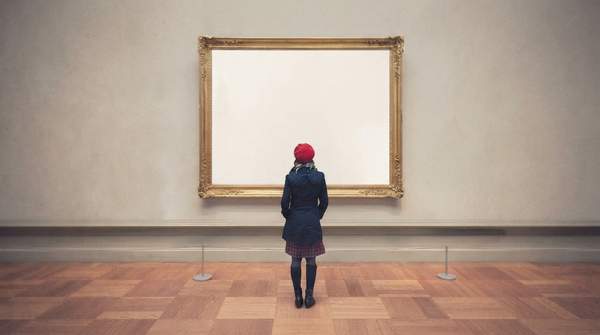
Slow Looking is the viewing-side counterpart, promoted by museums including Tate and LACMA. LACMA, which runs mindfulness and meditation programs alongside its exhibitions, notes that there is no single way to mindfully experience a work of art—all you need is dedicated time, anywhere from 5–10 minutes up to an hour.
- Choose an artwork and set aside time. Pick one piece and commit to staying with it rather than touring the room.
- Observe the whole. Take in the entire work first before zooming in on anything.
- Focus on details. Tate advises making the familiar strange and trying to "spot the details hiding in plain view," letting your mind make connections—whether intended by the artist or unique to you, both are valid.
- Notice your responses. Pay attention to how your mind and body react, however subtle: Tate suggests asking whether the work calms you, irritates you, excites you, or triggers memories. Don't force out distractions like nearby footsteps or conversation—Tate treats them as part of the fun of slow looking.
- Look again. LACMA's guidance is direct: "The more you look, the more you will see!" Some artworks only open up after sustained attention.
Museum educator Claire Bown adds structure for those who want it, drawing on Shari Tishman's definition of slow looking as a "mode of learning, a means of gaining knowledge through observation," with four strategies—categories, open inventory, scale and scope, and juxtaposition—all designed to push you beyond the first glance.
Why These Practices Work: The Psychology of Mindful Engagement
Both exercises work by shifting attention from outcome to process. Mehlomakulu observed that people appreciate the experiential nature of drawing the breath precisely because they stop worrying about the drawing's end result; Mindful Creative Muse echoes this, emphasizing honest expression over "perfect things." When self-criticism has nothing to evaluate, it loses its grip, and the conditions for flow—absorption in the present task—become available.
On the research side, a meta-analytical review of mindfulness and creativity published in a peer-reviewed academic journal notes that creative tasks are underpinned by distinct cognitive processes, which may be affected differently by mindfulness—a reminder that "creativity" is not a single thing these exercises boost. The review's own framing, following earlier researchers, is that differentiating forms of creativity matters for understanding the link. What the practical evidence supports more modestly is this: open, non-judgmental attention creates space for conscious inquiry and personal connection rather than habitual thinking or purely intellectual analysis.
Mindfulness in Art: A Comparative Guide to Practice
The two exercises are complementary tools for different situations—facing a blank canvas versus standing in a museum. The table below contrasts them across their goal, core action, and primary benefit so you can choose the one that fits your immediate aim.
| Dimension | Drawing Your Breath (Creation) | Slow Looking (Appreciation) |
|---|---|---|
| Goal | Enhance the process of making art, fostering creativity and overcoming blocks | Deepen appreciation of and personal connection to an existing artwork |
| Core action | Simple, repetitive mark-making linked to the breath, using minimal materials | Extended, focused observation—taking in the whole, then details, then your own responses |
| Primary benefit | Quiets the inner critic, builds awareness and focus, and supports entering creative flow | Sharpens observation, invites fresh perspectives, and allows deeper personal meaning-making |
| Time and setting | Short sessions, done often, anywhere with paper and pen | 5–10 minutes up to an hour, ideally in a gallery, museum, or at home with a single work |
Read the first column when your obstacle is starting to create; read the second when art feels distant, rushed, or mute. The practices are not interchangeable—each trains a different attentional muscle.
Integrating Mindfulness for a Richer Artistic Life
Readers should regularly practice either "Drawing Your Breath" for creative endeavors or "Slow Looking" for art appreciation, depending on their immediate goal, to cultivate a more engaged and less judgmental relationship with art. Start small: one five-minute breath-drawing before your next studio session, or ten unhurried minutes with a single artwork on your next museum visit, repeated until sustained attention feels natural rather than forced.
These are introductory practices, not a comprehensive mindfulness course, and they are not clinical art therapy—anyone seeking therapeutic support should consult a qualified professional. But as entry points they are unusually accessible, requiring no artistic ability and minimal time. The measurable indicator of progress is concrete: increased personal satisfaction from artistic activities, a reduction in creative blocks, or a deeper emotional and intellectual connection to artworks observed. Watch for those signs in your own practice, and let them tell you the exercises are working.
Sources
- What is Mindful Art? — Mindful Creative Muse — Mindful Creative Muse | Mindful Art Activities and Online Classes
- The Art of Mindfulness — Pallant House Gallery
- Drawing Your Breath - A Mindful Art Exercise - Creativity in Therapy
- A Step-by-Step Guide to Art and Mindfulness — Unframed
- A guide to slow looking — Tate
- What is Slow Looking? (and How Can I Get Started?) — thinking museum
- A meta-analytical review of the impact of mindfulness on creativity — PMC