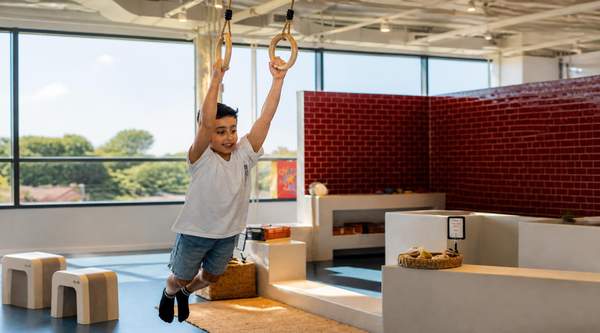
Toddlers rarely need much persuasion to move. Give them something low enough to climb, a space to roll, or an interesting route across the floor and they are already investigating what their bodies can do.
Tiny Gymnastics at Liliput Playhouse gives that instinct a little structure without draining the playfulness out of it. Geared towards children ages 1 to 3.5, the class introduces gymnastics foundations through tumbling, stretching, climbing, balancing, hanging, rolling, and supported movement.
Movement Becomes the Activity
Tiny Gymnastics begins with actions young children can understand through doing. A child does not need to know the vocabulary of gymnastics before trying to balance, roll, climb, hang, or move through a simple physical challenge.
The class gives those familiar impulses a guided setting. Soft equipment, obstacle-style stations, and age-appropriate instruction create opportunities to try different movements while an instructor provides direction and support.
Liliput presents Tiny Gymnastics as an introduction to gymnastics foundations, with activities designed around strength, flexibility, coordination, balance, and growing physical confidence. The emphasis stays on playful movement and age-appropriate challenges rather than competitive performance.
That approach fits naturally within Liliput’s Early Childhood Club. The broader programme invites young children to experience art, music, movement, sensory play, and cooking through direct participation rather than sitting back and watching.
Climbing Turns Curiosity Into a Route
For a toddler, climbing can begin with a wonderfully practical thought: can I get up there?
Tiny Gymnastics gives that curiosity somewhere appropriate to go. Children encounter climbing as part of guided movement activities, with equipment and stations arranged for the early-childhood age group.
Climbing also changes the way a child sees the space. What first looks like an object becomes a route, a challenge, or somewhere to reach before deciding what to try next.
There is a satisfying physical logic to it. Hands find a place, feet follow, the body shifts, and the child discovers that movement can be worked out one small action at a time.
Balancing Makes Slow Movement Interesting
Young children are often associated with speed, but balance can make slowing down just as absorbing. A narrow route or unfamiliar position asks for a different kind of attention from running freely across an open space.
Tiny Gymnastics incorporates balancing into its gymnastics-inspired activities alongside climbing, rolling, hanging, and tumbling. Children get opportunities to experiment with where their weight goes and how their bodies respond as they move.
The interest comes from the challenge itself. A child may pause, adjust, try again, or decide that crossing the obstacle in an entirely different way looks more appealing.
That gives the instructor something useful to work with while keeping the experience recognisably playful. The movement has direction without making every attempt feel like a test.
Rolling Makes the Floor Part of the Fun
Rolling may be one of the simplest movements in the class, but it changes the child’s relationship with the space immediately. Suddenly the floor becomes somewhere to travel across rather than simply stand on.
Tiny Gymnastics uses rolling and playful tumbling as part of its introduction to gymnastics foundations. Children can experience changes in position, direction, and momentum through movements suited to the early-childhood age group.
For toddlers, repetition can be half the appeal. One successful roll may lead directly to another, followed by the same movement again because apparently three times was nowhere near enough.
That willingness to repeat has a place in a class built around exploration. Familiar movements can sit beside new ones, giving children chances to return to something they enjoy while encountering fresh physical challenges.
Hanging and Stretching Change the Pace
A movement class becomes more interesting when every station does not ask the body to do the same thing. Hanging, stretching, climbing, balancing, and rolling create noticeably different physical experiences within the same session.
Tiny Gymnastics uses that variety to move children through different kinds of gymnastics-inspired challenges. One activity may ask for reach, another for balance, while another changes body position or introduces a supported attempt at something unfamiliar.
The pace can therefore shift as children move through the experience. Some challenges invite immediate action, while others may prompt a child to watch first and decide when they want to join in.
That room to encounter movement in different ways suits Liliput’s wider Early Childhood Club philosophy. The experience is guided, while young children still have space for curiosity inside it.
Trying Again Is Part of the Session
A toddler approaching a physical challenge may succeed immediately, abandon it halfway through, return five minutes later, or invent a method no adult anticipated. Tiny Gymnastics has room for that reality.
Liliput describes the class around small challenges and repeated attempts. Children are encouraged to try, fall, get back up, wait for a turn, and experience pride in small achievements as they move through age-appropriate stations.
For parents, that can make the class appealing even if competitive gymnastics is nowhere on the family agenda. The attraction can simply be a structured place where a young child gets to climb, balance, tumble, hang, stretch, and roll with guidance.
Sometimes the clearest sign that an activity has landed is much simpler than mastering a skill. The child reaches the end of the station and immediately wants another turn.
The Setting Matches the Movement
Tiny Gymnastics currently takes place at Gulliver Playstudio, the fourth-floor play world within Liliput’s Avenue Road venue. Gulliver centres movement and artistic play sculptures, making it a natural setting for a class focused on physical exploration.
The Early Childhood Club also uses natural, vegan, child-friendly materials and gives children opportunities to move, listen, touch, create, cook, and explore. Tiny Gymnastics brings the movement side of that wider programme into focus.
Within Liliput’s broader “Where Play becomes Art” idea, movement has its own expressive place. A child climbing, balancing, choosing a route, and deciding to try again brings curiosity into the physical environment in a way that feels distinctly at home here.
That gives Tiny Gymnastics a recognisable Liliput character even though paintbrushes and clay are absent. The creative element lives in how children encounter the space, test movement possibilities, and respond to each new challenge.
Forty-Five Minutes of Class Comes With More Time to Play
Current Tiny Gymnastics sessions run for 45 minutes and include an additional hour of drop-in play before or after class. The class therefore has a defined period for guided movement while leaving another part of the visit open for play.
That extra hour can feel like a natural continuation after a movement-based session. A child who has spent the class climbing, balancing, rolling, and following stations still has time to follow their own interests within the play environment.
Tiny Gymnastics currently starts from C$40, with late-registration pricing based on the number of sessions remaining. Liliput also offers multi-class savings through its Early Childhood Club for families registering for more than one class.
The programme is currently scheduled on Mondays and Tuesdays, giving families two weekly options for fitting the class into their routine.
Come Ready to Move
Tiny Gymnastics is an active class, so the practical preparation is refreshingly short. Socks are required for everyone attending, including adults.
Liliput also recommends bringing a change of clothes for Early Childhood Club programmes. That is useful insurance for a morning built around young children getting physically involved rather than sitting neatly on the sidelines.
Frequently Asked Questions
What ages is Tiny Gymnastics at Liliput Playhouse for?
Tiny Gymnastics at Liliput Playhouse is currently geared towards children ages 1 to 3.5. The programme introduces young children to age-appropriate gymnastics-inspired movement in a guided setting.
What do children do in Tiny Gymnastics at Liliput Playhouse?
Tiny Gymnastics at Liliput Playhouse includes playful tumbling, stretching, climbing, balancing, hanging, rolling, and supported movement. Children encounter soft equipment and gymnastics-inspired challenges suited to the early-childhood age group.
How long is Tiny Gymnastics at Liliput Playhouse?
Tiny Gymnastics at Liliput Playhouse currently runs as a 45-minute class with an additional hour of drop-in play before or after the session. The format combines guided movement with separate time for open-ended play.
Where does Liliput Playhouse hold Tiny Gymnastics?
Liliput Playhouse currently holds Tiny Gymnastics at Gulliver Playstudio on the fourth floor of its Avenue Road venue. Gulliver is Liliput’s movement-focused play world, giving the class a setting aligned with physical exploration.
How much does Tiny Gymnastics at Liliput Playhouse cost?
Tiny Gymnastics at Liliput Playhouse currently starts from C$40. For late registration, pricing is calculated according to the chosen start date and the number of sessions remaining.
Give All That Toddler Energy Somewhere to Go
Climbing, balancing, hanging, stretching, and rolling already make sense to children who would rather investigate a space than sit still inside it. Tiny Gymnastics gives those movements a guided place to happen while keeping curiosity and play at the centre of the experience.
For a young child who is happiest in motion, book Tiny Gymnastics for a morning built around trying, moving, and coming back for another turn.