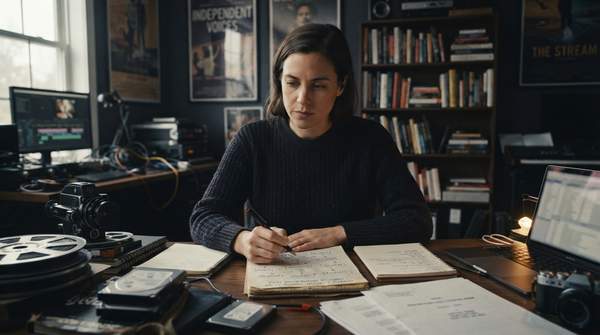
In 2017, computer scientist Joy Buolamwini discovered that leading facial recognition algorithms failed to accurately detect dark-skinned faces or classify women, revealing a hidden bias in technology meant to be objective. This finding, detailed on PBS, starkly exposed how deeply embedded biases can compromise systems designed for broad application. Her work provided a critical early warning about technology's potential to amplify existing societal inequalities.
Technology is lauded for its potential to solve complex problems and connect the world, but its unchecked development often creates new, insidious forms of discrimination and surveillance. The promise of efficiency clashes with the reality of unintended consequences, where innovation can inadvertently erode privacy and perpetuate biases.
As AI and data-driven systems become more pervasive in daily life, investigative journalism and documentaries become vital in holding power accountable and shaping public discourse around ethical tech governance. This scrutiny offers essential checks on powerful industries.
Key Documentaries Unmasking Tech's Hidden Dangers
1. Coded Bias
Best for: Anyone concerned with AI ethics and civil rights.
Premiered March 22, 2021, this Emmy-nominated documentary follows M.I.T. Media Lab computer scientist Joy Buolamwini as she uncovers algorithmic bias in facial recognition systems. Her research demonstrated these algorithms often failed to accurately detect dark-skinned faces or classify women, as reported by PBS. The film offers direct, actionable insights into AI's impact on civil liberties, revealing how unchecked code can govern human freedoms.
2. The Social Dilemma
Best for: Social media users and parents seeking to understand digital platforms.
This documentary presents a compelling case against screen-based technology's attention extraction model, highlighting how platforms are designed to keep users engaged, according to 500 Days of Film. It exposes the mechanics of social media addiction and manipulation, revealing the psychological costs of pervasive connectivity.

3. iHuman
Best for: Individuals interested in the future of AI development and privacy.
The film issues a stark warning about data use, privacy, surveillance, and advanced AI development, as detailed by 500 Days of Film. It offers a comprehensive look at broad AI implications, raising critical questions about human agency in a rapidly advancing technological landscape.
4. The Great Hack
Best for: Citizens concerned about data privacy and democratic processes.
Included as the fourth documentary on an IMDb list of best computer & technology documentaries, its title, 'The Great Hack,' strongly implies a deep dive into how personal data can be weaponized for political influence. This focus on real-world political ramifications of data exploitation is crucial for understanding modern democratic vulnerabilities.
5. Do You Trust This Computer?
Best for: Anyone pondering the ethical future of AI and automation.
Ranked as the first documentary on an IMDb list of top computer & technology documentaries, this film directly questions the trustworthiness of advanced computing systems. It compels viewers to consider the profound risks of relying heavily on AI and automated decision-making across all sectors.
6. Google and the World Brain
Best for: Researchers and scholars interested in digital information control.
Google and the World Brain appears as the third entry on an IMDb list of computer & technology documentaries. It likely examines Google's ambitious project to digitize all the world's books and the resulting controversies over copyright, information control, and the centralization of knowledge. The film offers a historical perspective on the power dynamics of information access and corporate influence.
7. AlphaGo
Best for: Enthusiasts of AI development and human-machine interaction.
Featured as the second documentary on an IMDb list of leading computer & technology documentaries, this film chronicles the historic match between Google's AI program AlphaGo and Go world champion Lee Sedol. It offers a visually compelling narrative of AI achievement, showcasing the rapid advancement of machine learning and its implications for human intellect.
The Dual Threats: Surveillance and Algorithmic Discrimination
| Threat Category | Key Figure | Exposure Method | Primary Impact |
|---|---|---|---|
| Mass Government Surveillance | Edward Snowden | Whistleblowing and investigative documentary ('CitizenFour') | Revealed pervasive, unchecked government monitoring of citizens, eroding privacy and civil liberties, as depicted in 'CitizenFour' according to 500 Days of Film. |
| Algorithmic Bias | Joy Buolamwini | Scientific research and public advocacy ('Coded Bias') | Demonstrated how facial recognition algorithms fail to accurately identify diverse populations, perpetuating discrimination and raising questions about AI's objectivity, as shown in her work on PBS. |
The revelations from whistleblowers like Edward Snowden and researchers such as Joy Buolamwini confirm that technological threats range from systemic government surveillance to insidious algorithmic discrimination. Both impact fundamental freedoms, demanding public attention and external checks on technological power.
From Discovery to Legislative Action
Uncovering technological flaws and enacting policy changes demands significant public advocacy. Computer scientist Joy Buolamwini, whose research highlighted biases in facial recognition, later testified before Congress to push for the first-ever legislation governing facial recognition in the United States, as reported by PBS. This direct link between scientific discovery, public awareness, and legislative action proves the critical role of individuals and media in advocating for ethical technology, showing that systemic issues require persistent pursuit of truth beyond industry standards.
If public demand for transparency continues to grow, tech giants like Google or Meta may prioritize user privacy and implement more rigorous ethical review processes for new AI systems in upcoming product launches.