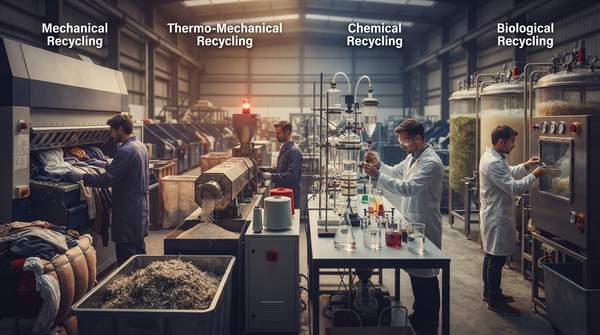
Textile recycling today rests on four fundamentally different technical routes—mechanical, thermo-mechanical, chemical, and biological—and each one carries a distinct bargain between maturity, output quality, cost, and the range of fabrics it can realistically handle. According to the U.S. Government Accountability Office, the field's central tension is stark: mechanical recycling is established but degrades fiber quality, while the newer chemical and biological approaches can preserve or rebuild polymer quality but remain constrained by cost, complexity, and immature infrastructure. Understanding those trade-offs, rather than any single technology, is what defines the current state of textile recycling.
Understanding Textile Recycling Technologies
The core problem is scale and diversity. As the GAO notes, many textiles—clothing, upholstery, carpets and similar materials—can be recycled to extend their useful life, and both pre-consumer manufacturing waste and post-consumer garments are potential feedstock. But the routes for doing so differ sharply depending on material, and the quality of recycled products varies with the approach taken.
A scientific review published by SCIEPUBLISH, "Advances in Recycling and Reuse Technologies for Textile Fiber Material Products," frames the field as a spectrum running from purely physical processes to biological ones. Industry trade publication Recycling Inside adds that the choice of route should start from the feedstock itself: post-industrial waste is cleaner and more uniform than post-consumer textiles, which shapes everything downstream. The four routes below occupy different points on that spectrum.
Mechanical Recycling: The Established Method
Mechanical recycling is the industry's workhorse, and it works by force alone. The GAO describes it as physically deconstructing fibers through methods such as shredding, crushing, or melting, before the fibers are reprocessed back into yarn. Recycling Inside gives the concrete sequence: fabric is shredded, torn, and carded back into fiber, then re-spun or directed into nonwovens and fillers. No polymer chemistry changes—the material is simply broken apart and rebuilt physically.
That simplicity is both its strength and its ceiling. The GAO reports that mechanical processing produces weaker fibers and lower-quality textiles with limited uses, such as furniture stuffing or insulation, and that the method is most effective for single-material textiles like 100 percent cotton, degrading further when applied to blends. Recycling Inside confirms the pattern: shorter fibers and lower strength mean output is often blended with virgin fiber, and mixed textiles recycle poorly. An EU-backed analysis of scaling textile recycling adds the economic consequence—mechanically recycled fibers destined for open-loop uses command a much lower potential sales price than virgin-quality regenerated fibers that can flow back into garment production.
Thermo-mechanical Recycling: Heat-Assisted Processing
Thermo-mechanical recycling is best understood as the heat-driven branch of the mechanical family: the fabric is melted rather than torn, then re-extruded into pellets or fiber. The GAO's description of mechanical recycling includes melting among its physical deconstruction methods, and Recycling Inside's comparison treats the thermo-mechanical route as a distinct lane within that physical approach—heat and pressure, not chemistry, do the work.
The melting step narrows the feedstock considerably. Because the process depends on the polymer flowing, it suits thermoplastic fibers that can be melted and reformed—Recycling Inside identifies clean polyester and nylon as its targets. The limitations mirror mechanical recycling's broader ones: the route is sensitive to blends, dyes, and finishes, and the thermal process can degrade polymer chains, affecting final product quality. Contamination, in other words, is the controlling variable.
Chemical Recycling: Dissolution and Depolymerization
Chemical recycling splits into two mechanisms with different levels of polymer breakdown. Dissolution dissolves the polymer to purify it—Recycling Inside describes fibers being dissolved, purified, and spun into new fiber, with cellulose regenerated into man-made cellulosic fiber—while leaving the polymer chain itself intact. Depolymerization goes further, breaking polymers down into their original monomers or oligomers, which are then purified and re-polymerized into new fiber-grade material, rebuilding the polymer from its basic building blocks.
The material fit differs accordingly. Recycling Inside lists cotton, viscose, and other cellulose fibers as dissolution's domain, while depolymerization targets polyester (PET) and nylon 6. Both routes carry heavier burdens than mechanical processing: dissolution involves solvent handling, dye removal, lower yields, and the need to strip out synthetic contamination first, while depolymerization demands energy and chemical inputs, with some processes running slowly or requiring catalysts.
The SCIEPUBLISH review adds the decisive economic caveat: chemical treatment involves expensive reagents, solvents, and catalysts that are often more costly than mechanical recovery, so the process economics still need optimization before recovery is commercially attractive at scale.
Biological Recycling: Enzyme-Based Solutions
The newest route outsources the chemistry to enzymes or microorganisms. The SCIEPUBLISH review explains that biological recycling uses these agents to break down polymer materials in waste textiles, converting them into monomers or other valuable products such as cellulose and bioethanol. Compared with traditional mechanical and chemical recycling, it offers low energy consumption, mild processing conditions, and environmental friendliness, typically operating under gentler conditions with more environmentally benign reagents.
Those advantages explain why the approach has drawn attention as an eco-friendly option in recent years, but the review also signals where the field stands: it is an emerging technology whose promise rests on sustained gentle conditions rather than demonstrated industrial throughput. The trade-off, then, is a mirror image of mechanical recycling's—biological methods aim for quality and environmental lightness where mechanical methods already deliver volume, and neither yet delivers both.
Comparing Textile Recycling Technologies
Synthesizing the GAO's technology overview, Recycling Inside's route-by-route comparison, and the SCIEPUBLISH review's scientific analysis into a single view reveals the pattern that defines the field: the more a route preserves or reconstructs polymer quality, the more it demands of cost, chemistry, and feedstock purity.
| Technology | How It Works | Best Suited For | Key Limitations |
|---|---|---|---|
| Mechanical | Physically deconstructs fibers by shredding, crushing, or tearing without altering the polymer, then re-spins or forms them into nonwovens and fillers | Single-fiber textiles such as 100 percent cotton or wool | Shorter, weaker fibers and lower-quality output with limited uses; degrades further on blends |
| Thermo-mechanical | Melts the textile and re-extrudes it into pellets or fiber—a heat-driven subset of mechanical processing | Thermoplastic fibers that melt and reform, such as clean polyester and nylon | Sensitive to blends, dyes, and finishes; heat can degrade polymer chains and lower output quality |
| Chemical: dissolution | Dissolves and purifies the fiber, then spins it into new fiber—cellulose can be regenerated into man-made cellulosic fiber—without breaking the polymer chain | Cotton, viscose, and other cellulose fibers | Solvent handling, dye removal, lower yields; synthetic contamination must be removed first |
| Chemical: depolymerization | Breaks the polymer into monomers or oligomers, then purifies and re-polymerizes them into fiber-grade material from the basic building blocks | Polyester (PET) and nylon 6 | High energy and chemical use; some processes are slow or require catalysts; reagent costs exceed mechanical recovery |
| Biological | Uses specific enzymes or microorganisms to break down polymers into monomers or products like cellulose and bioethanol | Polymer materials in waste textiles, under mild conditions | An emerging route; advantages in energy and gentleness are not yet matched by demonstrated industrial scale |
Read across the rows and the trade-offs sharpen: mechanical and thermo-mechanical routes are established and physically simple but lose quality on every cycle, while dissolution, depolymerization, and biological routes recover quality at the price of solvent systems, costly chemistry, or unproven scale. No route yet handles blends well, which is why the sorting question looms over all of them.
Overcoming Systemic Obstacles to Widespread Adoption
The obstacles holding back textile recycling are systemic, not specific to any one route. The GAO's headline finding is that mechanical and chemical technologies are both limited by a lack of supporting infrastructure, and that technologies able to preserve textile quality and separate blended materials are still in development. Material suitability, high costs, and environmental considerations round out the obstacles it identifies to widespread recycling.
Blended fabrics are the technical crux. The SCIEPUBLISH review notes that blends contain a variety of components—PET, cotton, and nylon together—and that efficiently separating those components to improve the efficiency and purity of chemical recycling remains an important industry challenge. Recycling Inside's practical guidance reinforces the same dependency from the buyer's side: invest in sorting and pre-processing first, because those stages decide the value of the output.
Cost is the second structural barrier, and it spans the full technology range. The SCIEPUBLISH review flags the economics of chemical recovery—expensive reagents, solvents, and catalysts—as a key issue. An EU-backed scaling analysis quantifies the spread: as technologies mature toward 2030, setup costs for textile recycling stretch from roughly €280 to almost €4,000 per output ton depending on the technology, with virgin-quality regenerated fibers commanding far higher prices than mechanically recycled open-loop fibers. That gap between input cost and output value is what determines which routes can actually close their books.
Navigating the Future of Textile Recycling
To advance textile recycling, stakeholders must prioritize investment in improved sorting infrastructure, develop cost-effective processing for blended fabrics, and scale up chemical and biological methods. The evidence base supports each pillar of that decision: the GAO names missing infrastructure as the binding constraint, the SCIEPUBLISH review ties chemical and biological methods' promise to unsolved blend separation and reagent economics, Recycling Inside ranks sorting and pre-processing as the value-determining stage, and the EU analysis shows the €280-to-€4,000-per-ton cost spread that scale must close.
The measurable indicator to watch is increased investment in automated sorting technologies and the establishment of new, larger-scale chemical or biological recycling facilities. Those are the concrete developments that would show the trade-offs in the table above shifting—higher-quality routes moving down their cost curves, and blends moving from the liability every source flags toward the feedstock every route can process.