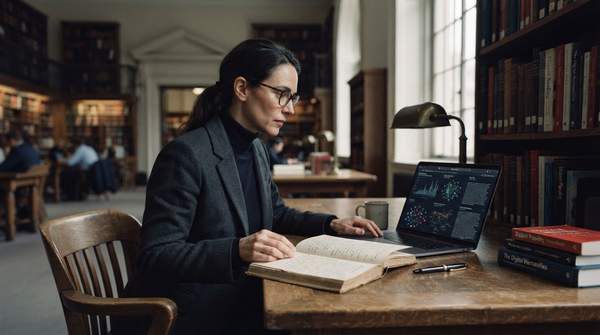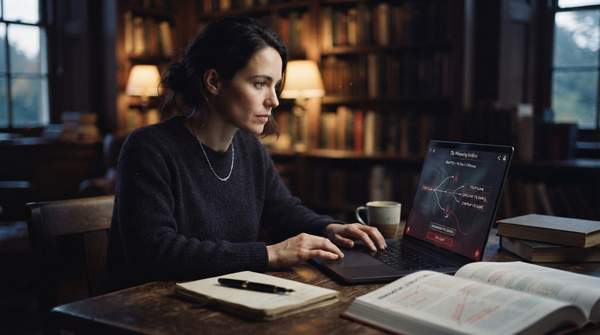
Literature now has two rival answers to the question of what to do about AI-assisted writing. The established answer is detection and exclusion: rewrite prize rules, label human-written books, and treat machine-generated prose as a violation to be caught. The new answer, embodied in France's freshly launched Prix Pascal de Littérature IA, is transparency and declared collaboration: let authors work with AI openly, and judge the result. The launch of the prize, announced in October 2026 by three French tech entrepreneurs, turns a theoretical debate about authorship into a concrete, rule-bound experiment.
Introduction: The Shifting Sands of Authorship
The Prix Pascal arrives at a combustible moment. As Euronews's David Mouriquand reported, the prize launched after weeks of controversy over AI use by finalists for several literary awards, including France's most prestigious, the Prix Goncourt. The News International's Bisma Saleem noted that the Commonwealth short story prize and the Caine Prize have likewise faced questions about possible AI involvement in submitted works. In one case reported by TRT World, the Canadian publisher Boreal confirmed that the writer Orelien had used artificial intelligence in his writing process, after weeks of denials.
Against this defensive backdrop, the Prix Pascal deliberately invites the machine inside. RTÉ, citing AFP, described the initiative as intended to challenge other prizes that are struggling to regulate AI. The prize's own framing, quoted by Euronews, is pointed: "AI is already present in writing workshops, in manuscripts and in bookshops, often unnoticed." The Pascal Prize, its website states, "asks the question aloud: what constitutes a work of literature when the author and the machine collaborate?"
Traditional Authorship: The Detection and Exclusion Model
The traditional model rests on an old and largely unspoken premise: a literary work is the product of a single human intelligence, and its value flows from that origin. As Dr. V. Saujanya argues in a 2026 study published in the International Journal of Engineering Research & Technology, generative AI tools capable of producing "coherent, stylistically rich, and contextually relevant literary texts" raise critical questions about creativity, originality, and "the role of the human author in the digital age."
The industry's initial response has been gatekeeping. Organizers of established prizes are rewriting their rules to exclude AI-generated submissions, while initiatives to label books as written by humans gain ground, according to reporting carried by RTÉ and TRT World. The logic is protective: if the value of a prize lies in rewarding human creative achievement, then undisclosed machine involvement is a form of fraud against judges, readers, and competing writers. A Diplo blog post on AI in creative writing acknowledges that in competitions where the goal is to evaluate original human work, questions about "how much AI?" are justified and necessary.
Yet the detection approach has an awkward feature: it treats AI use as something to be discovered rather than declared. The Diplo piece argues that as a general approach to reading texts, asking "Was this written with AI?" is surprisingly limited, and that it would be a mistake to generalize from competition rules into blanket suspicion of any AI use in writing.
The Prix Pascal: A New Paradigm of Transparency and Collaboration
The Prix Pascal inverts the burden. Rather than hoping to catch AI use, it requires it to be documented. Entrants must submit a manuscript plus a technical dossier specifying the algorithmic assistance used, and applicants must explain which AI model and prompts they employed, according to The Bookseller and The News International. All major language models are allowed, including ChatGPT, Claude, Gemini and LLaMA. Submissions must be in French, between 10,000 and 50,000 words, and open to writers worldwide.
The prize's organizers are explicit that this is not a celebration of the technology for its own sake. The website insists the prize "is not a technology competition." Named for Blaise Pascal, the French mathematician and philosopher who helped develop an early mechanical calculator, the award is positioned as provocation rather than product placement. The mechanics are still forming: there is no jury yet and no declared prize money. Applications opened in late October 2026 and close at the end of November, with ten shortlisted manuscripts to be selected and a winner announced in early-to-mid December, judged by a planned panel of five or six writers, critics, journalists, philosophers and publishers.
Challenging Literary Theory: AI and the 'Author-Function'
Why does a writing tool feel so much more disruptive than, say, spell-check? Literary theory supplies part of the answer. Saujanya's study traces the challenge back to Roland Barthes, whose essay The Death of the Author argued that a text's meaning is constructed through language and reader interpretation rather than authorial intention, and to Michel Foucault, who in What Is an Author? described the author as a socio-cultural construct—an "author-function" that organizes discourse rather than a fixed origin of meaning. AI-generated texts, the study argues, make this construct newly visible and contested: if the author was always partly a cultural fiction, machine writing forces the question of who, or what, now occupies that function.
The study's conclusion is that the future of literature lies in human-AI collaboration, in which human authors contribute critical thinking, emotional depth and contextual awareness while AI provides efficiency, pattern recognition and stylistic versatility. In this model the human becomes what might be called a creative anchor—the party responsible for judgment and intention—rather than the sole producer of every sentence. Traditional concepts of authorship and originality, Saujanya writes, "are no longer sufficient to explain machine-assisted writing." The Prix Pascal's required technical dossier is, in effect, an attempt to give that collaborative author-function a documentary form.
Comparing Authorship Models in the Age of AI
The two models can be set side by side. The traditional column reflects the implied principle behind detection-and-exclusion rules; the Prix Pascal column reflects its organizers' explicit philosophy.
| Dimension | Traditional Model: Detection & Exclusion | Transparency Model: Prix Pascal |
|---|---|---|
| Core principle | Sole human creativity and originality as the basis of literary value | Declared human-AI collaboration as a new basis for evaluation |
| Role of author | Individual sole creator responsible for all creative input | Human as creative anchor, openly working with AI tools |
| Treatment of AI | Detect AI-generated content and exclude it from awards and submissions | Accept AI as a tool, requiring explicit declaration of models and prompts used |
| Industry response | Prizes rewriting rules to exclude AI submissions; human-written labeling initiatives growing | New awards launched specifically for AI-assisted works, intended to challenge existing regulations and provoke debate |
| Central question | Was this written with AI? | What constitutes a work of literature when author and machine collaborate? |
Read side by side, the columns show that the disagreement is not about whether AI is present—it demonstrably is—but about whether the appropriate response is suspicion or disclosure. Neither model is self-evidently superior: exclusion protects the integrity of human-only competition but invites an unwinnable policing effort, while transparency normalizes collaboration but leaves the value of the resulting work an open question.
Unresolved Questions and Practical Challenges for the Industry
Whichever model prevails, the industry faces questions that no rule set has yet answered. RTÉ and TRT World both highlight the thorniest: will authors be allowed to use services such as ChatGPT or Claude for research or writing advice, and when does AI-assisted research become AI writing? The boundary is undefined, and the Diplo distinction between AI as a primary author and AI as an auxiliary instrument, while conceptually clean, gives no operational test for drawing it.
Publishing commentator Jane Friedman, writing on her industry blog, adds a practitioner's perspective: ghostwriting, editorial collaboration, research assistants, dictation and spell-check have always aided authors' output, and writing is not, in her view, a zero-sum game. Her suggestion is that the writer who leans on AI is mostly at risk of cheating themselves—and that the question of cheating the reader turns on whether the use is known and disclosed. That framing points toward disclosure standards rather than detection regimes, but who sets those standards, and what they require, remains unsettled.
Navigating the Future of Authorship: A Call for Transparency
The publishing industry and authors must move towards a framework of transparency and declared collaboration regarding AI use, rather than relying solely on detection and exclusion. The Prix Pascal is the first concrete institutional test of that position: a prize whose rules assume AI involvement, demand documentation of it, and ask judges to evaluate the work that results. The measurable indicator to watch is increased adoption of AI declaration requirements in literary submissions and awards, similar to the Prix Pascal model. The prize's own near-term milestones offer a concrete check: submissions close at the end of November 2026, the jury is expected to be announced in early November, and a winner is due in December—outcomes that will show whether declared collaboration can sustain a literary competition at all.
Sources
- Prix Pascal: New French literature prize launched for books co-written with AI — euronews
- AI-written books can now win a literary prize as France launches Prix Pascal — The News International
- TRT World - France unveils AI literary prize amid debate over authorship — Trtworld
- Literary prize launched for books written with AI — RTE.ie
- Reimagining Authorship: The Impact of Artificial Intelligence on Literary Creativity and Narrative Construction – IJERT
- AI in creative writing: Authorship over detection - Diplo
- New literary prize Prix Pascal launches in France for manuscripts written with AI — The Bookseller
- Royalliteglobal
- Writing & Publishing Awards Have Difficult Decisions to Make Regarding AI — Jane Friedman