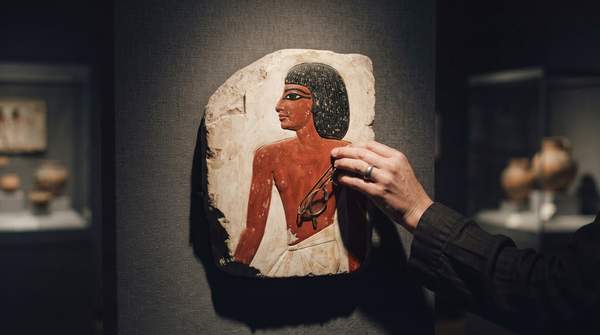
Color in ancient Egyptian art cannot be read with modern eyes. The most common mistake is assuming that black, which many Western viewers associate with death and evil, carried the same meaning on the walls of a tomb. It did not. As Joshua J. Mark explains in his study of color in ancient Egypt, images of Tutankhamun with black skin were originally interpreted by early archaeologists as expressions of death and grief, when a proper reading connects the dead king with Osiris and the concept of rebirth and resurrection. Understanding this gap between ancient and modern associations is the key skill for anyone looking at Egyptian artifacts.
Decoding Ancient Egyptian Color Symbolism: A Comparative Guide
The Egyptians used color as a language, and like any language it has to be translated rather than assumed. The clearest way to see how far the translation has to travel is to set the documented Egyptian meanings beside the associations that dominate modern Western culture today. The contrast is sharpest for black, partial for red, and smallest for white, which Mark notes "retains the same meaning in the present day that it had for the ancient Egyptians."
| Color | Ancient Egyptian Meaning | Common Modern Western Association | Contextual Interpretation |
|---|---|---|---|
| Black | Association with Osiris, rebirth, and resurrection, as in tomb images of Tutankhamun with black skin. | Evil, death, and grief — the association that led early archaeologists astray. | Black skin on a deceased king points to resurrection through Osiris, not mourning; the link to death is real, but the meaning is renewal. |
| Red | Not fixed: in a given painting it might symbolize evil or destruction, but it should not always be read that way. | Love, passion, and lust, but also danger and aggression. | Red's meaning shifts with each composition; the surrounding scene, not the pigment itself, determines the message. |
| White | The same meaning it carries today, though it too must be interpreted in context. | Purity and related ceremonial associations. | A rare case of continuity: the modern reading does not mislead, but context still governs. |
Used as a quick reference, this key does two things at once. It flags where a modern reflex will produce a wrong reading — above all with black — and it shows which colors demand a closer look at the scene before any conclusion is drawn. The Egyptian meanings recorded here are specific to that culture's religious context, while the modern column reflects widely shared Western associations that individuals may still vary on.
Context is Key: Interpreting Nuance in Egyptian Art
Why could a single color carry such different charges? Mark draws a direct parallel to reading hieroglyphic writing, where the direction the figures face tells you which way to read the message: the direction itself provides the context that makes the text intelligible. Color, he argues, works the same way. "In a certain painting, red might symbolize evil or destruction but the color should not always instantly be interpreted along those lines."
That single sentence carries the central lesson of Egyptian art interpretation. Red is not a fixed sign for one concept; it is a sign whose value is assigned by the composition around it. A viewer who approaches a tomb painting with a modern Western palette of meanings — where red leans toward passion or danger — faces a double risk: the modern association is wrong for the culture, and even the correct Egyptian association is not constant from one scene to the next.
The practical method follows from the hieroglyphic comparison. Before assigning meaning to a color, look at what surrounds it: who is depicted, what is happening, and what direction the scene moves in. The same pigment on a different wall, or in a different register of the same wall, can be making a different statement. This is why the early archaeologists' reading of Tutankhamun's black skin failed — they isolated the color from its religious context and substituted their own culture's mourning associations.
Beyond the Palette: The Enduring Legacy of Egyptian Color
What the Egyptian system demonstrates is that color symbolism is cultural, not universal. The same black that signals grief at a modern Western funeral signaled resurrection in a royal tomb; the same red that colors a stop sign or a Valentine today could signal destruction in one Egyptian painting and something else entirely in another. Neither system is arbitrary — each draws on the beliefs that structured its world — but they are not interchangeable.
For anyone studying Egyptian art, this has a practical consequence: the artifact cannot be read through intuition. The tomb images of Tutankhamun are the standing example. What early excavators took as an expression of death and sorrow is, on a contextual reading, a statement of hope — the dead king identified with Osiris, the god associated with rebirth. The grief the archaeologists projected was real enough in ancient Egypt, as Mark acknowledges, but it was not what the color was saying.
The scope of this framework has limits worth naming. It applies to ancient Egypt and its contrast with modern Western culture; it is not a guide to color symbolism across all world cultures, and it rests on art historical and Egyptological interpretation rather than the physics or psychology of how color is perceived. Within those bounds, it turns color from decoration into evidence — a record of what the Egyptians believed about life, death, and divinity.
Applying Context: A Deeper Understanding of Egyptian Art
When encountering ancient Egyptian art, actively consider the specific cultural and religious context of each color rather than applying modern Western interpretations. The test of whether you have absorbed the method is simple: the ability to articulate at least two distinct, context-dependent meanings for a single color — red standing for evil or destruction in one painting while resisting that reading in another — in ancient Egyptian art. Reach that point, and the black-skinned Tutankhamun in his tomb will read to you as he was meant to: a king bound for rebirth.
Sources
- Color in Ancient Egypt — World History Encyclopedia
- Color symbolism - Wikipedia — EN